See what changed
Review people needing follow-up, new connections, and groups showing a meaningful change in engagement.
For pastors and Life Group leaders
Gatherflow turns attendance and group engagement into a Monday list of who needs a check-in — with an owner for every follow-up — so no one falls through the cracks.
Keep the tools you already use. Planning Center sync is coming soon — confirm what's live during onboarding.


Most churches pay separately for services planning, texting, check-in, a website, and a mobile app — then still can’t see who slipped out of Life Group last month. Gatherflow collapses that stack into one bill, with discipleship at the center.
attendance, This week follow-up, group ownership
weekends without a second spreadsheet
guests and families into the same people record
announcements that reach the people who need them
public site tied to the same church, not a fifth vendor
One pathway. One people record. One bill.
Answers for churches exploring Gatherflow, pathways, and pastoral follow-up.
Discipleship Intelligence is the practice of using church engagement information, personal check-ins, and ministry context to help leaders understand participation in discipleship and guide meaningful next steps.
Group attendance, pathway milestones, serving, and conversations can reveal opportunities for encouragement or care. These signals inform a conversation; they cannot prove spiritual maturity or tell the whole story of a person's relationship with God.
View this answer in the guideA Discipleship Intelligence Platform is church software that organizes discipleship pathways, group participation, and engagement information so ministry leaders can decide who to encourage, where follow-up is needed, and what next step to offer.
Gatherflow brings this approach to Life Groups, pathways, and pastoral follow-up. A leader reviews the context, reaches out personally, and records an appropriate next step. AI may assist with summarizing signals, but this approach does not require AI or a spiritual-growth score.
View this answer in the guideA church management system (ChMS) typically organizes church operations, such as people records, attendance, events, giving, and scheduling. Discipleship Intelligence focuses on interpreting relevant information to support discipleship pathways and pastoral next steps.
The categories can overlap, and ChMS products may also offer groups, workflows, and care tools. Gatherflow's emphasis is connecting participation and pathway context with follow-up. Churches can evaluate that approach alongside existing systems without assuming every operational tool must be replaced.
View this answer in the guideChurch Relationship Management (ChRM) emphasizes relational connections and pastoral care: who is connected, who may be isolated, and who needs a personal interaction. Discipleship Intelligence also considers the person's pathway and the next step that may support their discipleship.
Both approaches can help leaders notice disconnection and respond with care. The distinction is an emphasis, rather than a strict boundary or an industry-wide standard. Gatherflow brings relationships, Life Groups, pathway milestones, and engagement context into the same ministry conversation.
View this answer in the guideGatherflow brings Life Groups, discipleship pathways, attendance, and follow-up into one ministry workflow. Leaders organize participation, review the information available, and use that context to offer personal care or a meaningful next step.
A practical rhythm is to organize groups and pathways, record participation and milestones, review changes each week, and assign a leader to follow up. Repeated missed meetings can prompt a check-in rather than an automatic judgment about someone's faith. During a demo, confirm which modules and connections are available for your church.
View this answer in the guideChurches do not have to replace Planning Center to explore Gatherflow. Gatherflow's discipleship focus can sit alongside existing operational tools; replacing individual tools is an optional decision based on the church's needs and available Gatherflow modules.
Keeping both products does not mean they automatically sync. Planning Center integration is currently coming soon. Review your workflows, data-entry requirements, and module availability with Gatherflow before making a migration decision.
View this answer in the guidePlanning Center integration is planned, but automatic Planning Center sync is not currently available in Gatherflow. The connection is marked Coming soon in the app.
Contact Gatherflow to discuss current onboarding options and integration status. Do not assume a launch date, supported Planning Center products, two-way sync, or automatic data transfer until those capabilities are confirmed.
View this answer in the guideChurches can review participation and self-reported milestones alongside personal conversations, testimonies, and a leader's knowledge of the person. Track opportunities for discipleship and care without ranking people by spiritual maturity.
Useful questions include whether people can find a group, receive follow-up, and take the next step they have chosen. Aggregate trends can expose gaps in ministry processes. Attendance, giving, or task completion alone cannot establish spiritual growth; missing records are unknown information, not evidence of failure.
View this answer in the guideChurches can look for changes from a person's usual participation, such as repeated missed group meetings, a pause in serving, or unanswered check-ins, then ask a trusted leader to make a personal check-in.
Confirm that records are complete and consider travel, illness, work schedules, caregiving, or a group change. Three missed meetings might justify asking how someone is doing, but do not establish that the person is drifting spiritually. Use signals to invite care, and let the person explain their situation.
View this answer in the guidePastors can use AI to assist with administrative summaries and possible follow-up suggestions while retaining human judgment, personal relationships, and responsibility for ministry decisions.
Use only data the church is authorized to process, minimize sensitive information, restrict access, and review the provider's privacy and data-use terms before submitting pastoral notes or prayer requests. Verify summaries against source records and check suggestions for errors or bias. AI should not assign spiritual-worth scores, make autonomous pastoral decisions, or send sensitive messages without review. These are recommended practices, not a claim that every safeguard is already implemented in Gatherflow.
View this answer in the guideDefine what growth looks like at your church, understand where people are, and help every leader guide the next meaningful conversation.
A person is known and welcomed.
They find meaningful community.
Faith becomes active and rooted.
Gifts become participation.
Disciples begin making disciples.
Explore Gatherflow alongside the systems your church already uses. Planning Center integration is planned; automatic sync is not available yet. Ask about current connection and onboarding options.


Gatherflow organizes the work around the pastoral questions your team is already asking—not around a generic software feature list.
Bring group involvement, milestones, conversations, and care context into one trustworthy ministry view.
See where each person is on your pathway and give leaders a clear, personal action to take next.
Put the right context, reminders, and follow-up prompts in the hands of the people doing ministry every week.
Understand group health, participation, leader capacity, and where new community needs to be formed.
Surface meaningful changes in engagement early enough for a thoughtful conversation—not an automated response.
See movement across groups and pathways without reducing spiritual formation to a shallow scorecard.
Move from scattered activity to shared pastoral awareness—simple enough for volunteer leaders and useful enough for your ministry team.
Give staff and trusted leaders a shared view of relationships, group involvement, milestones, and open follow-up—so care begins with context.
James Rivera
Young Adults
Sarah Chen
Family Life
Marcus Thompson
Men's Group
Aisha Lewis
Women's Group
Understand where pathways are gaining momentum, which groups need support, and where engagement is changing while keeping pastoral judgment at the center.
87%
Avg Attendance
24
Active Groups
12
New Members
Weekly Engagement
Turn ministry insight into simple prompts, relevant context, and timely conversations your volunteer leaders can confidently act on.
Young Adults
2mDon't forget — group meets Thursday at 7pm!
Family Life
1hPrayer request from the Johnson family...
Men's Group
3hGreat time at the retreat last weekend!
Women's Group
1dNew study material has been posted 📖
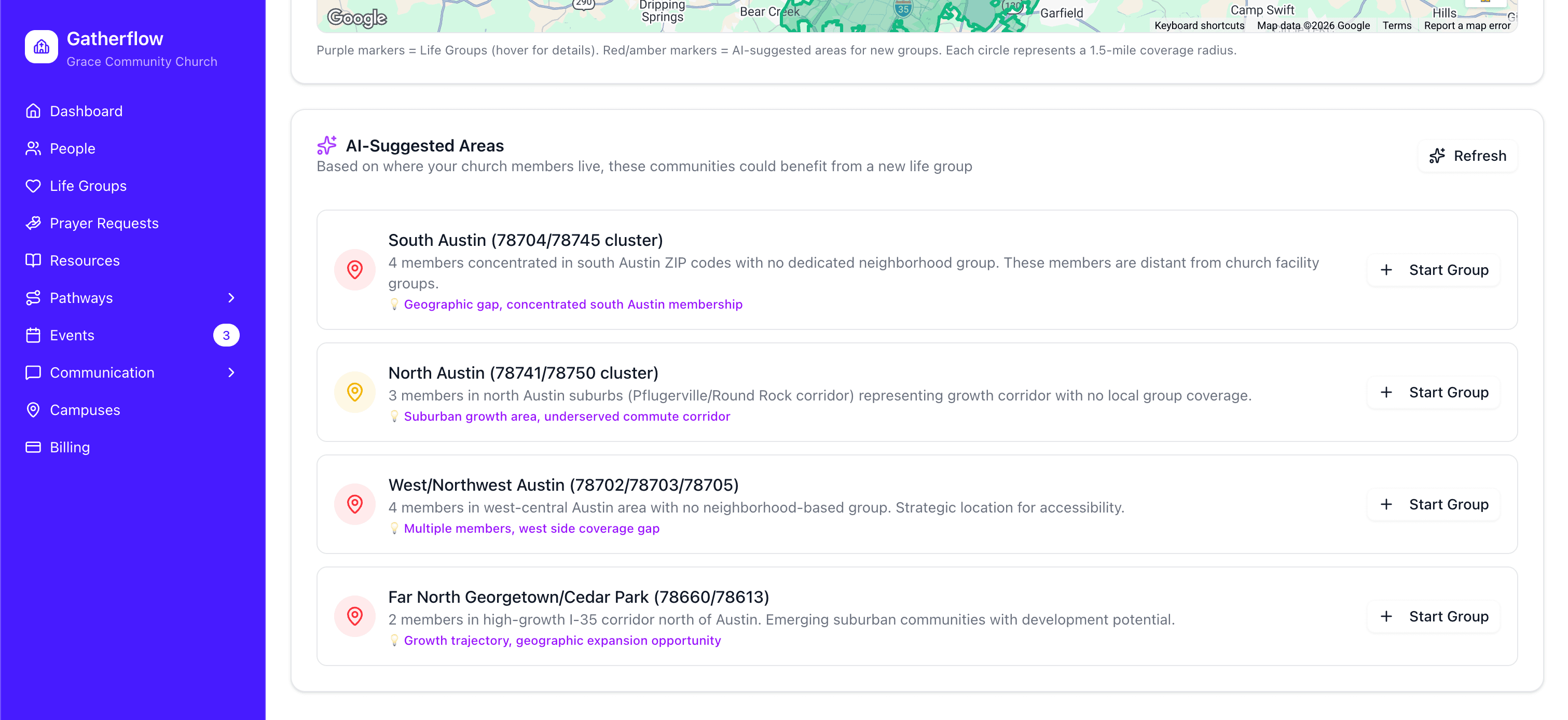
Understand where people live, where existing groups are reaching, and which neighborhoods may be ready for a new leader and a new community.
Gatherflow helps your team move from information gathering to timely pastoral action—with fewer meetings, fewer spreadsheets, and clearer ownership.
Walk through your ministry workflowReview people needing follow-up, new connections, and groups showing a meaningful change in engagement.
Give staff and ministry leaders one shared view of priorities, ownership, and the conversations that matter.
Send relevant context and simple next actions without asking volunteers to become database administrators.
Capture new relationships and place people into a clear, personal next-step process while the moment is still fresh.
$99/mo locked for life, 12-month commitment, white-glove onboarding, and direct input on the roadmap. Limited founding seats. This is a partnership program, not a coupon.
Live product walkthrough
See Life Groups, attendance, and This week follow-up in one place — tailored to your church.
We'll be in touch within 1 business day to confirm a time.
No one falls through the cracks
Most systems store people. Gatherflow surfaces engagement — attendance, groups, and milestones become a Monday list of who needs a touch this week, with an owner for every follow-up. Personal check-ins, before anyone disappears.